
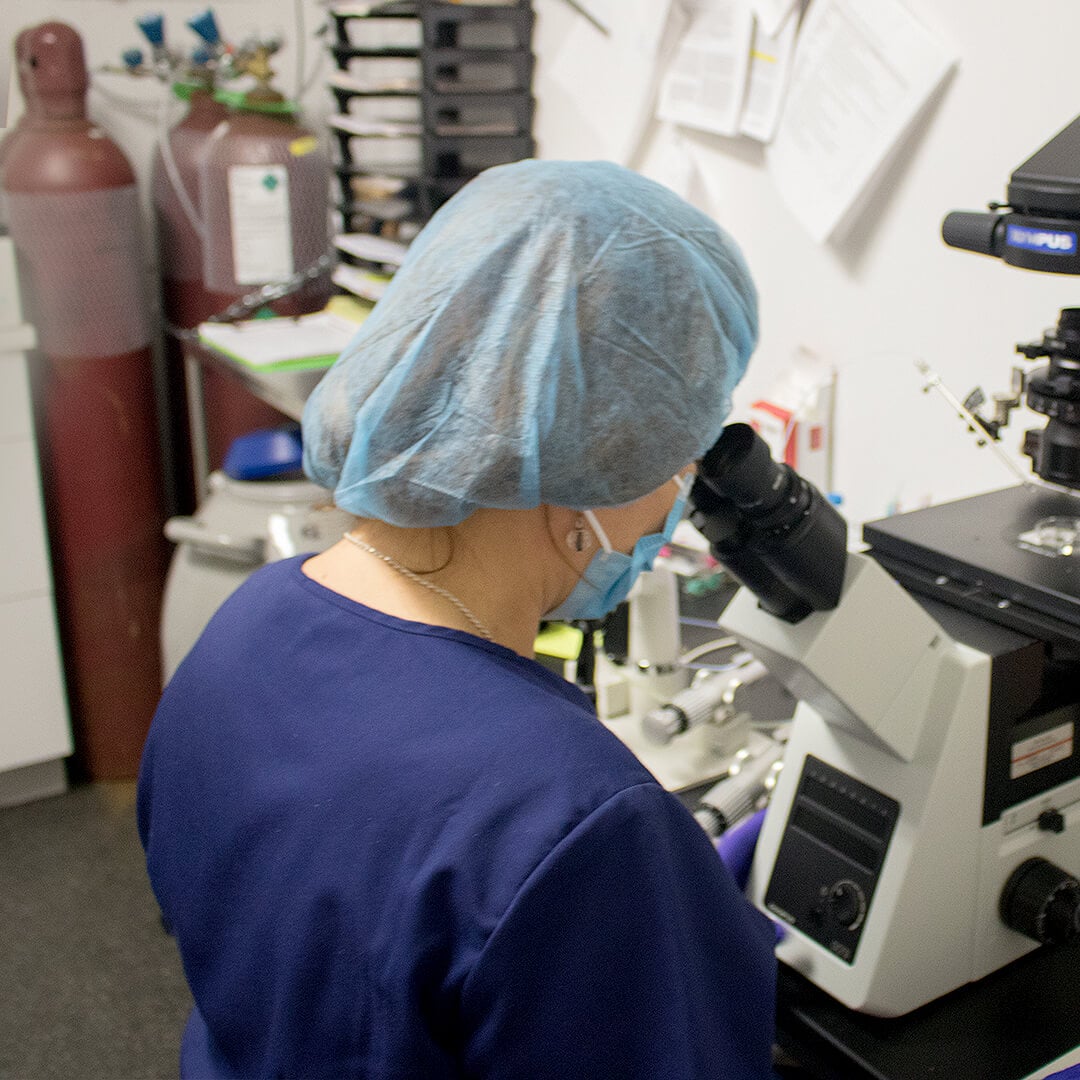
Egg freezing, sometimes called "social" or "elective" egg freezing, is an increasingly popular family planning option for women in their 20s and 30s who wish to preserve their fertility for future family building goals.
Egg freezing gives women the opportunity to conceive their own biological child within a wider time frame. In recent years, the procedure has emerged as a different approach to medical egg freezing (fertility preservation), which is used when a woman is facing treatment or surgery that would put her fertility at risk, such as a cancer diagnosis. We invite patients to learn more about the potential freedoms egg freezing can provide.
What is egg freezing?
The actual process for egg freezing is the same as fertility preservation during which the patient will undergo ovarian stimulation and oocyte (egg) retrieval to obtain eggs that can be frozen and thawed at a later time when the patient is ready to have a child.
Approximately 20 frozen eggs is considered a reasonable number to freeze as insurance to later generate a pregnancy. With the use of cryoprotectants and cryotools, in combination with rapid freezing techniques (vitrification) and fertilization with ICSI, pregnancy rates using frozen and thawed oocytes are becoming standardized.
Chelsea Fertility offers patients a fee of $8,000 for one cycle.
Contact our office to request a consultation.
Who is a candidate for egg freezing?
The most common age range for women to freeze their eggs is around 32-36, but those who are younger or older are certainly candidates as well. Your doctor will ask that you discuss your motivation for freezing your eggs to ensure that this is the recommended course of action for your family planning needs. Some possible reasons for women to freeze their eggs include:
- The desire to put your career, education, or travel plans as a priority for the near future
- Not yet having found the right partner to start a family
- Wanting to plan for other life goals first, such as buying a house or further financial savings ahead of trying for a pregnancy
Why choose egg freezing?
Women often feel enormous pressure to choose between personal goals (career, education, travel, etc.) and those related to family planning. For every woman who thought she had to sideline her aspirations to make her dream of starting a family come first, egg freezing provides an opportunity. It allows you to conceive your own biological child later in life. This means you control the clock when it comes to setting your life's priorities.
Additionally, egg freezing has become increasingly affordable. At Chelsea Fertility, an egg freezing cycle costs $8,000 and this fee does not include cryostorage. For those women who are good candidates for the process, this investment toward ensuring future family planning needs is definitely a worthwhile consideration.
What the process involves
Egg freezing follows the first half of an IVF cycle. You take about ten to twelve days of hormone injections to grow multiple follicles, come in for monitoring ultrasounds and bloodwork every one to three days, and then have a short egg retrieval under IV sedation. Mature eggs are vitrified (flash-frozen) within hours of retrieval and stored in liquid nitrogen until you're ready to use them.
An egg freezing cycle runs about two to three weeks, depending on your protocol. Almost all patients continue working during stimulation. Monitoring is early morning and most appointments take 20–30 minutes. You'll need to take the retrieval day off and can typically return to normal activity within a day. Injections are self-administered and take a few minutes.
No credible evidence links egg-freezing hormone stimulation to increased cancer risk or long-term hormonal changes. Short-term risks include bloating, cramping, and rarely ovarian hyperstimulation syndrome (OHSS), which modern protocols largely prevent. We review all risks during your consult.
When to freeze: age and timing
Egg quantity and quality both decline with age, most noticeably after 35. Freezing in your late 20s to early 30s generally yields more eggs and a higher chance that a live birth results per frozen egg. Freezing in your late 30s can still be worthwhile, especially with more than one cycle. We review your AMH and antral follicle count first so you can make the decision with real numbers, not marketing language.
How many eggs should I freeze?
The figure most fertility specialists work from is 15 to 20 mature frozen eggs to eventually yield one delivery. The reason is attrition at every stage: not every egg fertilizes, not every fertilized egg reaches the cleavage stage, not every one of those becomes a blastocyst, and not every blastocyst has a normal chromosome count. In a 35-year-old, roughly 15 eggs tends to yield one to two chromosomally normal embryos after PGT-A. Those numbers become less favorable with age.
For the same reason, frozen eggs are an insurance policy, not a guarantee. Not every egg survives thawing, not every thawed egg fertilizes, and not every fertilized egg develops into a healthy embryo. What egg freezing does is preserve today's egg quality for use later, when your natural egg quality has declined. That's a meaningful advantage, but it's a probability, not a promise.
The clearest reference point for what freezing and thawing can achieve comes from egg donor cycles — young, fertile donors, normal sperm parameters, and genetically tested embryos — where pregnancy rates approach 70%. That figure measures the technique under the most favorable conditions in the field, not what you should expect if you are freezing your own eggs. Your own outcome depends on your age at the time of freezing, the number of eggs retrieved, and your own egg quality, so the donor-egg number is best read as a benchmark for the process rather than a prediction of your individual result.
Outcome depends not only on the number of eggs but on egg quality as a function of age, and on sperm quality and the age of the male partner. The permutations are complex, which makes universal figures difficult to quantify.
Although the accepted number of mature eggs to freeze to generate one delivery is 15-20, this was developed from IVF experience in women age 35 or less. Increased age will require more eggs simply because quality and resultant embryos derived from these eggs decreases with age. The best guess can be derived from data showing euploid embryos as a function of age. Furthermore, the original algorithm is from IVF cases involving women having conception delay. For the typical woman who is freezing eggs and never has tried to attempt pregnancy the number required could be significantly less if her egg quality within that particular age group is higher.
Storage, and changing your mind
There is no established time limit on frozen egg storage. Vitrified eggs have been successfully thawed and used for pregnancy more than a decade after freezing, and the storage temperature (liquid nitrogen) essentially halts biological aging. Annual storage fees run $1,000 to $1,500 per year depending on the package length, and are billed separately from the cycle fee.
If you later decide not to use your frozen eggs, you have several options: continue storage, discard the eggs, donate them to research, or (in most states, with legal counsel) donate them to another patient. You control what happens to your eggs and can change your directive at any time.
Cost, and medical versus elective coverage
A single elective egg freezing cycle at Chelsea Fertility NYC is $8,000. That covers the medical cycle itself; medications are billed through a specialty pharmacy and long-term egg storage is billed separately as an annual fee. A growing number of employers now cover egg freezing as a benefit, often administered through Progyny, Carrot, Maven, WINFertility or Stork Club. Patients here have had benefits administered through Carrot, Maven and WINFertility. What your benefit covers is set by your employer's plan rather than by us, so we verify it before you begin — call 212-685-2229.
The distinction between elective and medical freezing matters financially. Elective egg freezing, done to preserve fertility for future family building, is rarely covered directly by commercial insurance, though it may be supplemented by your employer. Egg freezing that is medically indicated — to preserve fertility ahead of chemotherapy or radiation that will affect ovarian function — is more often covered. We will work with your insurer to determine what your plan allows, and our financial counselors can discuss available options if egg freezing is not covered under your plan. See insurance coverage and our full fee schedule for details.
If a medical diagnosis is what brings you here, medical fertility preservation describes the process for patients facing cancer treatment, surgery or other conditions that put ovarian function at risk.
How to Get Started with Egg Freezing
We encourage those interested in egg freezing to talk to our physicians about the process. We'll be able to answer questions and clear up any confusion about everything from treatment and storage costs to what's involved from start to finish. We offer a free consultation for new patients — call 212-685-2229 for a personalized estimate, or contact the specialists at Chelsea Fertility of New York City. You can also read the full egg freezing and fertility preservation FAQ.