
The IVF Process Step by Step
- 1
Initial Consultation
Meet with your fertility specialist to review your medical history, discuss goals, and create a personalized treatment plan.
- 2
Ovarian Stimulation
Injectable fertility medications are used for 8-14 days to stimulate the ovaries to produce multiple eggs. Regular monitoring with blood tests and ultrasounds tracks your progress.
- 3
Egg Retrieval
A minor outpatient procedure performed under light sedation. Using ultrasound guidance, eggs are gently retrieved from the ovaries. The procedure takes approximately 15-20 minutes.
- 4
Fertilization
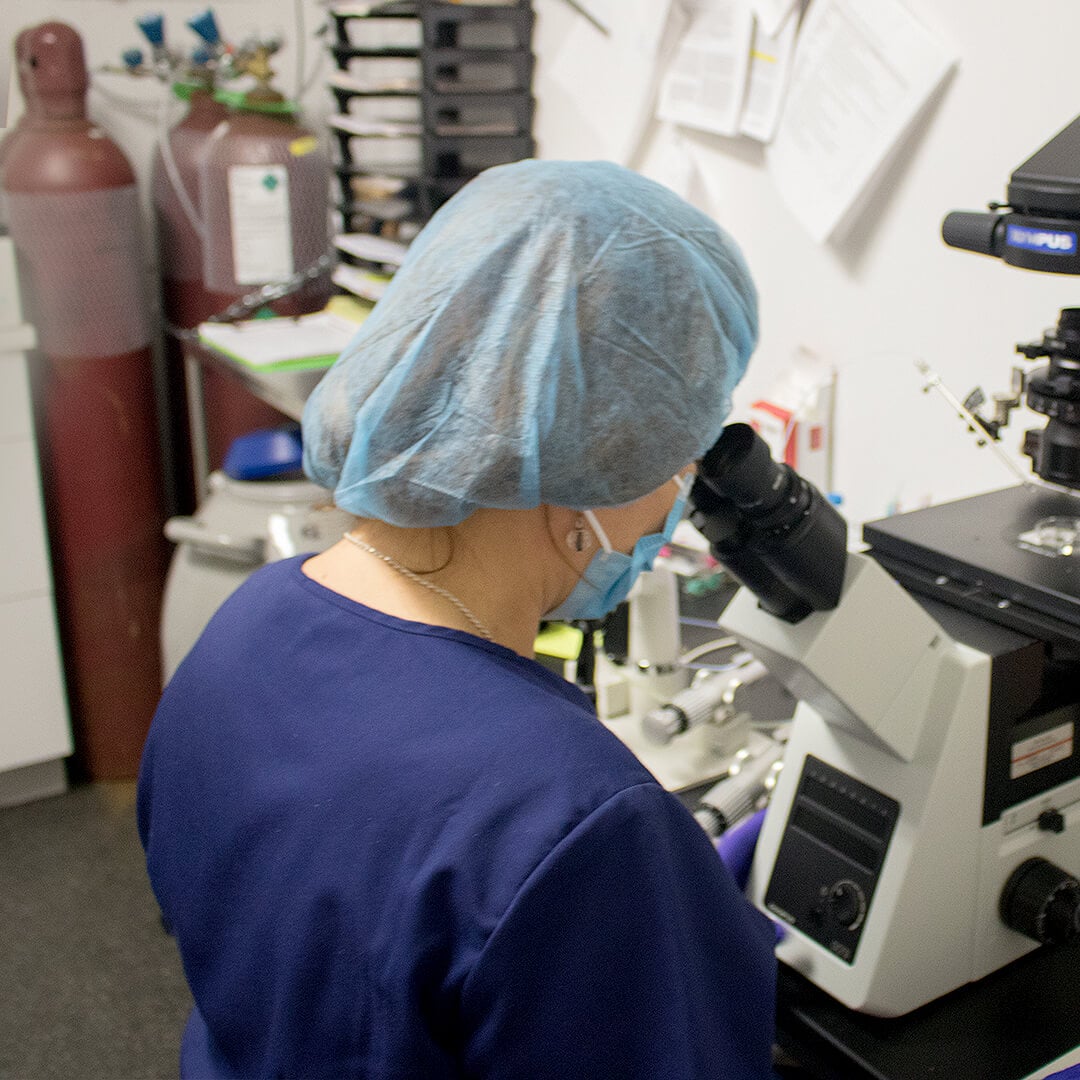
Retrieved eggs are fertilized with sperm in our state-of-the-art laboratory. ICSI may be used to inject a single sperm directly into each egg for optimal fertilization rates.
- 5
Embryo Culture
Embryos are carefully monitored as they develop over 3-5 days. Our embryologists assess embryo quality to select the best embryo(s) for transfer.
- 6
Embryo Transfer
One or more embryos are gently transferred into the uterus using a thin catheter. This is a painless procedure that does not require anesthesia.
- 7
Pregnancy Test
Approximately 10-14 days after the embryo transfer, a blood test (beta-hCG) confirms whether pregnancy has been achieved.
How long a cycle takes
An IVF cycle ending in a fresh transfer tracks roughly a full menstrual cycle — about a month. A freeze-all IVF cycle runs about two to three weeks, depending on your protocol. Most patients continue their normal activities throughout.
The medications
Most protocols use injectable follicle-stimulating hormone (FSH) and often a luteinizing hormone (LH) component to grow eggs, plus a second medication to prevent premature ovulation. A trigger injection finalizes egg maturation before retrieval. After transfer, progesterone supports the uterine lining. Your nurse walks you through mixing, timing, and injection technique before you start.
What retrieval is actually like
The retrieval itself is done under short IV sedation, so you feel nothing during the procedure. Most patients feel bloated and crampy for a day or two afterward, similar to strong menstrual cramps, and return to normal activity within 24–48 hours. You need someone to escort you home from the procedure.
Fresh transfer or frozen transfer
Embryos can be transferred fresh, or frozen and then thawed for transfer in a later cycle. Neither is universally better. Some patients do better separating egg retrieval and transfer into two cycles; others don't. It depends on your history and on what has and hasn't worked before. Your physician will go through the advantages and trade-offs of each during your consultation so your cycle can be planned around your situation.
Whether to add genetic testing
PGT is optional and not right for every patient. It can reduce miscarriage risk and time to pregnancy for patients over 35, those with recurrent pregnancy loss, or known genetic conditions. For younger patients with good embryo quality, the added cost and small biopsy risk may not be justified. We give you a straight recommendation based on your situation.
Working through a cycle
Almost all patients continue working during stimulation. Monitoring appointments are early morning and typically take 20–30 minutes. You'll need to take the retrieval day off and can generally return to work the next day. Transfer takes about 30 minutes and requires no meaningful downtime — most patients go back to their day.
How many cycles
Many patients achieve pregnancy in one or two cycles with the best prognosis, but the outcomes depend on age, diagnosis, ovarian reserve, and embryo quality. Most patients do not do more than 2.5 cycles because of financial or personal issues rather than medical prognosis. After your workup we can give you a realistic per-cycle and cumulative expectation. If a cycle doesn't succeed, we do not simply repeat the same protocol — we review what we learned and adjust.
Risks of IVF
For good-prognosis patients — younger, with PGT-A-tested embryos — we transfer a single embryo, which minimizes the risk of a multiple pregnancy. For older patients or those with a poorer prognosis, transferring more than one embryo may be appropriate. Your physician will discuss which applies to you.
More questions are answered in our IVF FAQ, and you can read more about the treatment itself on our IVF page. For what a cycle costs and what is billed separately, see our cost and pricing page.